
From the Strait of Hormuz to the Grocery Aisle
If you’ve been to the grocery store in the last week, you’ve seen it: the price of a gallon of milk or a loaf of bread is climbing almost as fast as the price of a barrel of oil. As we navigate the fallout from the conflict in the Middle East and the closure of the Strait of Hormuz, most of the national conversation focuses on gas stations. But as someone who spends every day thinking about the “deep architecture” of our power systems, I’m looking at something even more fundamental.
I’m looking at our farms.
In 2026, American agriculture is essentially a process of turning energy into calories. From the diesel that powers tractors to the natural gas used to produce nitrogen fertilizer to the massive amounts of electricity required for irrigation and cold storage, food is energy.
When global energy markets catch a cold, the American food system gets pneumonia. The current spike to $120+ oil isn’t just a “transportation problem.” It is a systemic threat to agricultural microgrids and food security. If we want to keep our dinner tables affordable, we have to stop “importing” the energy used to grow our food.
The Energy-Food Nexus: A Systemic Vulnerability
To understand why we are in this predicament, we have to look at the math of modern farming. A typical large-scale operation in the Midwest or the Central Valley of California is incredibly energy-intensive.
-
Irrigation: In drought-prone regions, pumping water from deep aquifers is often the single largest electricity expense for a farmer. When the grid price spikes due to natural gas shortages, the cost of “watering” a crop can double overnight.
-
Cold Storage: For dairy, produce, and meat, the “cold chain” is non-negotiable. A single power outage or a week of “peak demand” pricing can wipe out a farm’s annual profit margin just to keep the refrigerators running.
-
Processing: Turning raw grain into flour or milk into cheese requires high-heat and high-motion industrial processes that currently lean heavily on a fragile, centralized grid.
The current crisis has exposed a painful reality: Our food security is currently tethered to the stability of the Persian Gulf. That is a strategic failure we can no longer afford.
The Solution: Harvesting the Wind and Sun as Crops
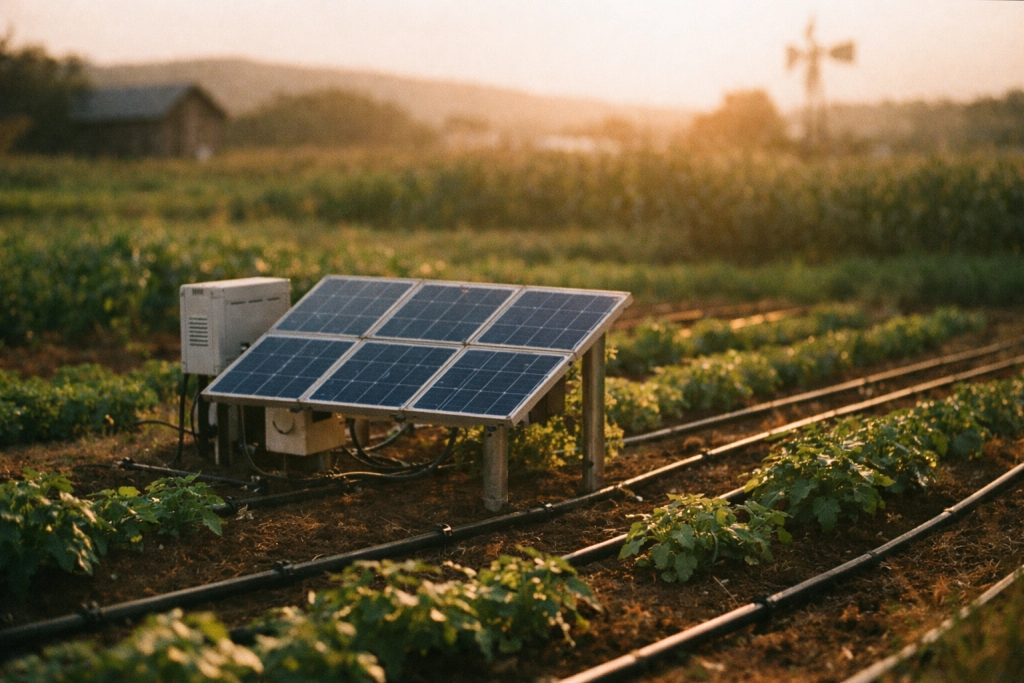
At Brevian Energy, our goal is to work with rural communities and large-scale C&I agricultural operations to deploy what we call “The Resilient Farm.” This isn’t just about sticking a few solar panels in a fallow field; it’s about a fully integrated agricultural microgrid.
By combining on-site generation (solar and wind) with long-duration battery storage and DERMS (Distributed Energy Resource Management Systems), we can help farmers decouple their “input costs” from global geopolitics.
1. Price Certainty in a Volatile World
The greatest threat to a farmer in 2026 isn’t just high prices; it’s unpredictable prices. You can’t plan a harvest if you don’t know what your electricity bill will be in six months. A microgrid turns a variable cost into a fixed asset. Once a Brevian microgrid is operational, the marginal cost of that next kilowatt-hour of irrigation is effectively zero. That is the ultimate hedge against inflation.
2. Eliminating the “Spoilage Risk”
During times of international conflict, the domestic grid often comes under increased stress—from cyber threats to physical supply shortages. For a poultry farmer or a commercial dairy, a four-hour outage isn’t an inconvenience; it’s a catastrophe. A microgrid with “islanding” capability ensures that even if the macro-grid fails, the farm’s critical life-support systems stay online.
3. Circular Energy: From Waste to Watts
In 2026, we are increasingly integrating anaerobic digesters into our agricultural microgrids. By turning livestock waste into biogas, farms can generate baseload power that complements the variable nature of solar and wind. This isn’t just “green”; it’s a masterclass in efficiency. You are taking a waste product that carries an environmental penalty and turning it into a fuel source that provides energy independence.
Equity and the Rural Divide
As an advocate for equity in energy, I am particularly concerned about our small-to-mid-sized family farms. While “Big Ag” may have the cash reserves to weather a $120 oil spike, the smaller operations that form the backbone of our local food sheds are often left behind.
This is why Brevian Energy focuses on flexible PPA (Power Purchase Agreement) financing. We believe that a farmer shouldn’t have to choose between upgrading their equipment or securing their energy future. By removing the “upfront capital” barrier, we allow farms of all sizes to tap into the same resilience that was once reserved for the Fortune 500.
Feeding the Future
We are at a turning point. The conflict in Iran is a wake-up call that we cannot continue to build our most essential systems—food and water—on a foundation of foreign-dependent fossil fuels.
Investing in agricultural microgrids and food security is more than just a smart business move for the individual farmer; it is a patriotic act of national defense. Every farm that goes “off-grid” or “grid-independent” is one less vulnerability in our national armor.
At Brevian Energy, we lead with discipline and a mission-first mindset. We are here to ensure that the American farmer has the tools they need to feed this country—without being held hostage by a shipping lane 7,000 miles away.
Is Your Farm or Processing Facility Ready for the Next Energy Shock?
Don’t let global volatility dictate your bottom line. Whether you’re managing thousands of acres or a regional processing hub, Brevian Energy can design a custom microgrid solution that locks in your costs and hardens your operations.