
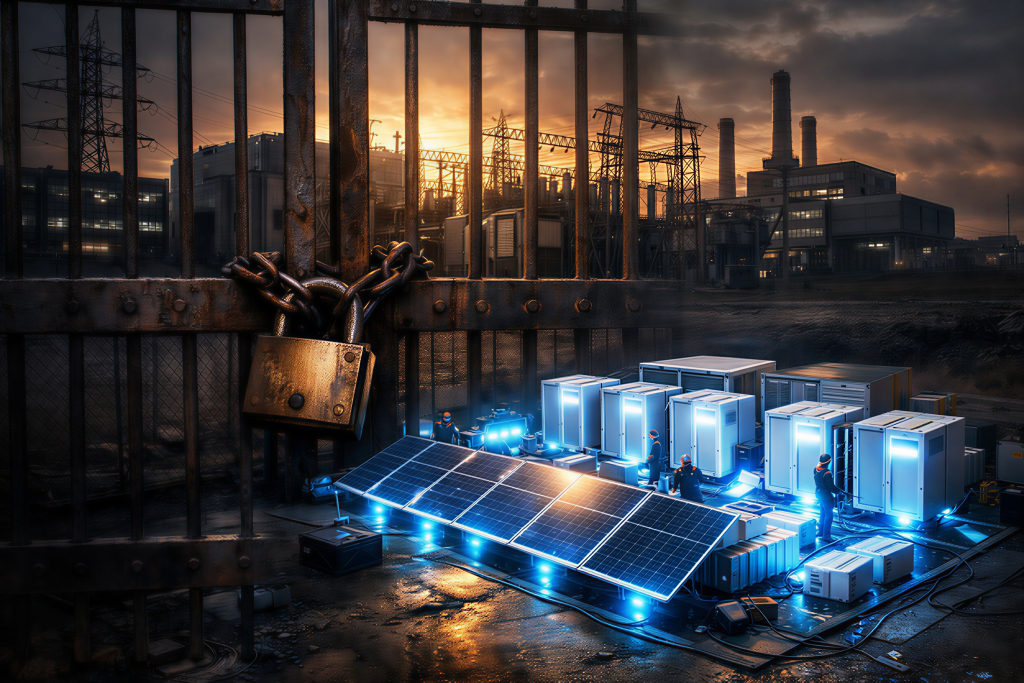
The “Permission to Grow” Crisis
In the Navy, we never waited for “permission” from the environment to complete a mission. We built our own infrastructure, moved our own fuel, and generated our own power because, at sea, the “grid” is whatever you bring with you. You adapt, or you fail.
As we kick off the last week of March 2026, many of you in the C&I (Commercial & Industrial) and data center sectors are facing a different kind of mission-critical failure. You have the capital, you have the permits, and you have the demand—but you’re hitting a wall called the “Substation Standstill.”
Right now, across the U.S., the average wait time for a new grid interconnection has stretched to an unprecedented 4 to 7 years. We are seeing a historic bottleneck where electricity demand, driven by the massive onshoring of manufacturing and the “AI power grab,” is rising significantly faster than the utility can build the transformers and substations to meet it.
In 2026, the utility isn’t just your provider; they’ve become your primary growth constraint.
The 2026 Reality: The Grid is Full
According to the latest 2026 Microgrid Market Research, “utility delays” are now the #1 reason industrial operators are abandoning traditional grid-tie models in favor of multi-DER microgrids. We’ve entered an era where being “grid-dependent” is synonymous with being “growth-stagnant.”
Consider the current landscape:
-
Load Growth vs. Infrastructure: U.S. electricity generation is struggling to keep pace with a roughly 1.2% increase in demand in 2026, largely driven by energy-intensive industries and data centers that can’t wait for five-year infrastructure cycles.
-
The Interconnection Stalemate: The time needed to review projects and complete the necessary infrastructure upgrades has increased “dramatically” as utilities struggle with technical reviews and the sheer volume of new requests.
-
Rate Volatility: Even if you can get connected, you’re walking into a market where rates have been far outpacing inflation—San Diego customers, for instance, are seeing some of the highest costs in the country, with rates reaching upwards of 41.5 cents per kilowatt hour.
Stop Asking for Permission to Prosper
At Brevian Energy, we are seeing a fundamental shift in how business leaders approach this crisis. We are moving away from “waiting for the utility” and toward Energy Sovereignty.
If you are a property developer or an industrial operator, you shouldn’t be asking a utility for “permission to grow” your operations. You should be building the “galley” right into your own ship.
The “Speed-to-Power” Advantage of Microgrids:
-
Bypassing the Queue: A standalone microgrid can often be deployed in 12–18 months, compared to the 60+ months required for a major utility substation upgrade.
-
Value-Stacked Optimization: In 2026, “simple” solar isn’t enough. The market now rewards complex, “value-stacked” systems that coordinate multiple assets—solar, long-duration storage, and AI-driven DERMS—to capture multiple revenue streams.
-
Risk Mitigation: By generating and managing your own power, you insulate your business from the “price jumps” occurring in wholesale markets like PJM, where capacity prices have seen near order-of-magnitude increases due to load growth and sluggish queues.
Equity in the Queue: The Human Side of the Bottleneck
As an equity advocate, I have to point out the darker side of this standstill. When the grid is “full,” the entities with the deepest pockets—the massive hyperscale data centers—often find ways to the front of the line, leaving local communities, small manufacturers, and municipal projects (like schools and clinics) stuck in the back.
This is where microgrids become a tool for Community Empowerment. By building localized, independent power clusters, we aren’t just solving a business problem; we are relieving the pressure on the entire system. We are ensuring that a community’s “mission” doesn’t have to wait for a global tech giant to finish its “power grab.”
The Mission for Monday: Take Command
The current energy crisis in the Middle East has proven that centralized, fuel-dependent systems are a liability. But the internal grid bottleneck in the U.S. is proving that centralization itself is the liability.
Don’t let your 2026 expansion plans sit in a utility’s inbox for the next three years. Take command of your power. Build your own “Freedom Grid.”
Brevian Energy was built to navigate these waters. We don’t just see a “full grid”; we see an opportunity for you to lead.
Is Your Expansion Stuck in a 5-Year Wait?
Stop waiting for a utility that can’t keep up with your business. Whether you are looking to bypass interconnection queues or secure your own “Mission-Critical Power,” Brevian Energy has the technical and financial expertise to get you offline and on-mission.