
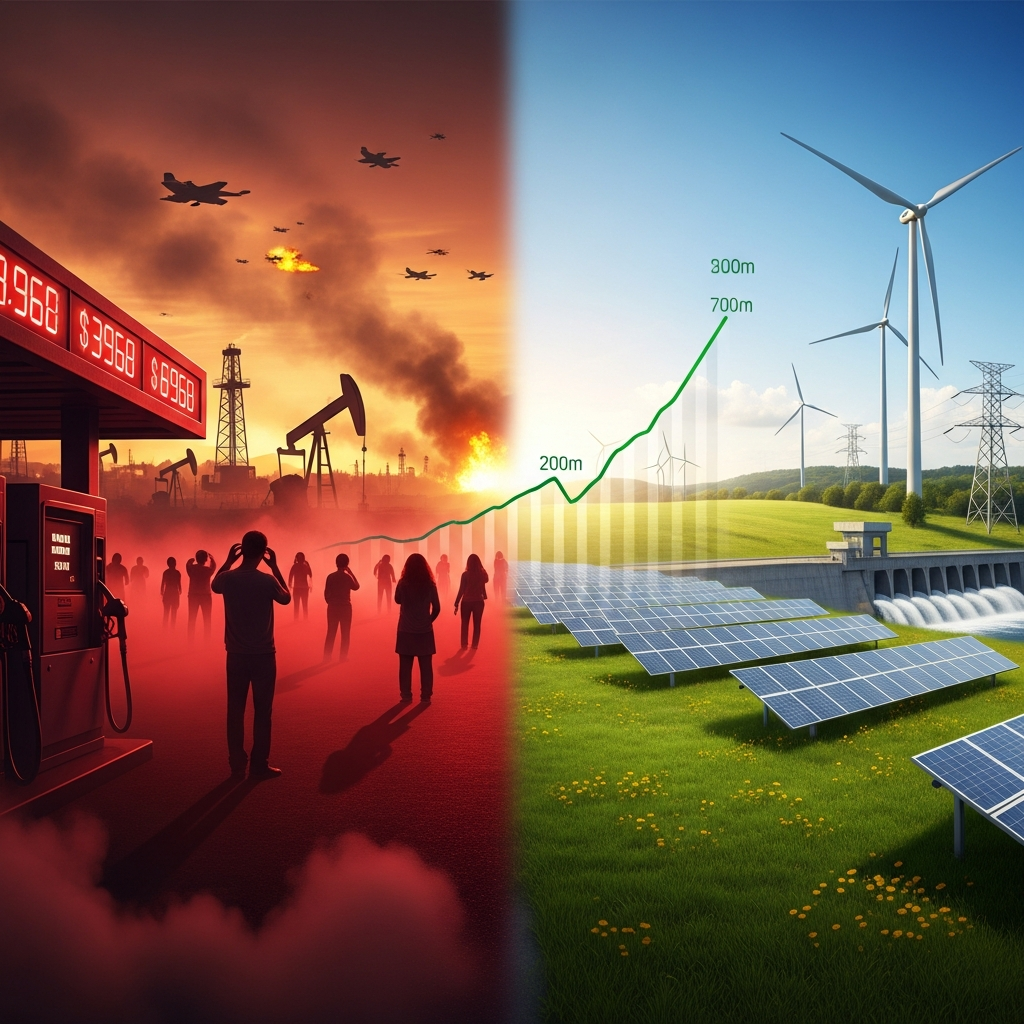
A $120 Lesson in Geopolitical Vulnerability
As I write this on March 23, 2026, the global energy market is reeling from a shock we haven’t seen in half a century. With the Strait of Hormuz effectively closed since early March and Brent Crude surging past $120 a barrel, the headlines are full of talk about “strategic reserves” and “emergency production.” But if you’ve been following the work we do at Brevian Energy, you know that the real story isn’t about how much oil we can pump—it’s about how quickly we can stop needing it from halfway across the world.
We are currently witnessing what happens when a single geographic chokepoint—a 21-mile-wide strip of water—holds the global economy hostage. Twenty percent of the world’s oil and liquefied natural gas (LNG) passes through that strait. When that flow stops, as it has during this current conflict with Iran, every American family feels it at the pump, and every business feels it in their operational costs.
But here is the hard truth: Energy security is national security. And as long as our grid is tied to global commodity prices that can be spiked by a drone strike or a naval blockade 7,000 miles away, we are not truly independent.
The Chokepoint Problem: Why Centralization is a Liability
For decades, the “old guard” of the energy industry has argued that centralized fossil fuel production was the bedrock of stability. The events of the last few weeks have exposed that as a myth.
The current crisis has created a systemic collapse of the traditional energy model. When Qatar declares force majeure on LNG exports because of regional instability, it doesn’t just affect Asia or Europe; it ripples into the U.S. natural gas market, driving up the cost of electricity for the very factories and data centers that are supposed to be driving our domestic “onshoring” boom.
In 2026, a centralized grid is vulnerable. Whether it’s a cyberattack on a major transmission line or a geopolitical conflict that triples fuel prices for “peaker” plants, the common denominator is dependence. We are dependent on long supply chains, dependent on foreign stability, and dependent on a global price floor that we cannot control.
Microgrids: Decoupling from Global Volatility
The solution isn’t just “more drilling.” While domestic production provides a buffer, it doesn’t insulate us from global price shocks. Oil is a global commodity; if the price goes up in the Persian Gulf, it goes up in the Gulf of Mexico.
True independence comes from decoupling.
This is where Microgrids and Renewable Energy move from “green initiatives” to “national defense assets.” When a business or a community installs a solar-plus-storage microgrid, they are essentially building their own private utility.
- Fuel Certainty: Sunlight and wind don’t have to pass through the Strait of Hormuz. They aren’t subject to maritime insurance premiums or retaliatory strikes. By harvesting energy locally, we eliminate the risk of a “fuel-short” scenario.
- Price Immunity: Once the capital expenditure of a microgrid is covered—often through flexible PPA financing—the cost of electricity becomes a flat line. While your competitors are watching their margins evaporate due to $120 oil, a microgrid-powered business has locked-in energy costs for the next 20 years.
- Grid Hardening: Our DERMS (Distributed Energy Resource Management Systems) allow these local “islands” of power to support the wider macrogrid. In a time of war or national emergency, a decentralized network of thousands of microgrids is virtually impossible for an adversary to “knock out.” It is the ultimate form of strategic resilience.
The “Freedom Grid” Manifesto
I’ve spent my career advocating for energy equity and technology integration, but today my focus is on American Energy Dominance. To me, dominance doesn’t mean just being the biggest exporter; it means being the most resilient.
A “Freedom Grid” is one that is:
- Distributed: Power is generated where it is consumed, reducing the “target surface” for physical or cyber threats.
- Domestic: It utilizes 100% American-harvested resources—sun, wind, geothermal, and domestic battery manufacturing.
- Autonomous: Using AI and DERMS, these systems can “island” themselves instantly if the main grid is compromised, ensuring that critical infrastructure—hospitals, water plants, and defense contractors—never goes dark.
We are currently seeing the U.S. administration extend deadlines and navigate the “Strait of Hormuz deadline.” These are necessary tactical moves, but the long-term strategic move is to ensure that by 2030, a conflict in the Middle East is an international news story, not an American economic catastrophe.
Leading the Charge at Brevian Energy
At Brevian, we aren’t waiting for the next crisis to act. We are already on the ground, helping C&I businesses and rural communities build their own “Freedom Grids.” We are using the current market volatility as a wake-up call to accelerate the deployment of solar, wind, and long-duration storage.
The mission is clear: We must build an energy system that is as resilient as the people it serves. We must ensure that our businesses can stay open, our factories can keep humming, and our homes stay powered, regardless of what happens on the other side of the globe.
The era of energy dependence is over—if we dare to build what comes next.
Is Your Business Vulnerable to the Current Energy Shock?
With oil and gas prices hitting historic highs due to the conflict in Iran, there has never been a more critical time to secure your energy future. Brevian Energy provides the expertise, the DERMS technology, and the financing to get your microgrid online fast.