
I’ve spent my career at the intersection of complex technology and human impact. If there’s one thing I’ve learned, it’s that you can have the most advanced, high-efficiency silicon carbide inverters and the most sophisticated AI-driven DERMS in the world, but if the people living next door to your project don’t trust you, your hardware is just expensive scrap metal.
As we move through 2026, the “energy transition” has shifted from a series of pilot programs into a massive, nationwide infrastructure build-out. We are seeing more solar panels, wind turbines, and battery enclosures being installed than at any point in history. But we’ve also hit a significant, often invisible wall: Siting.
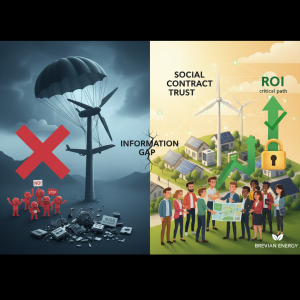
The old-school way of developing energy projects—what I call “the parachute method”—is dead. That’s the approach where a developer signs a land lease behind closed doors, files for permits in silence, and then “parachutes” into a town hall meeting six months later to tell the community what’s happening. In 2026, that is a recipe for litigation, delays, and ultimate project failure.
At Brevian Energy, we believe that a microgrid isn’t just a technical solution; it’s a social contract.
The High Cost of the “Information Gap”
The data on project delays in the mid-2020s is sobering. Recent industry reports from late 2025 indicate that over 35% of utility-scale renewable projects across the U.S. have faced significant delays or total cancellations due to local opposition.
When developers treat community engagement as a “check-the-box” compliance task, they invite three massive risks:
-
The “NIMBY” Narrative: In the absence of clear information, fear fills the vacuum. “Is it loud?” “Is it a fire hazard?” “Will it lower my property value?” If you aren’t there to answer those questions on Day One, someone else will answer them for you—often with misinformation.
-
Permitting Quagmires: Local zoning boards are sensitive to their constituents. If a room is full of angry residents, a simple permit that should take 60 days can easily turn into a two-year legal battle.
-
Stranded Capital: Millions of dollars in “soft costs”—engineering, legal fees, and interconnection studies—can be wiped out if a project is voted down at the final hour.
We have to stop viewing community engagement as a hurdle and start seeing it as the critical path to ROI.
The Brevian Framework: Moving from “Developer” to “Partner”
At Brevian Energy, we lead with transparency. We don’t hide our plans; we co-create them. Here is how we approach renewable energy siting to ensure long-term success.
1. The Pre-Blueprint “Listening Tour”
Before we finalize a single CAD drawing or order a single battery module, our team goes into the community. We don’t show up with a “final plan.” We show up with a blank map and a set of questions:
-
“Where are your recurring power outages happening?” * “What are the critical assets—schools, clinics, cooling centers—that need to stay online during a storm?” * “What are your concerns regarding land use and aesthetics?”
By asking these questions early, we often find ways to optimize the microgrid development. For example, we might discover that by shifting a solar array 50 yards to the north, we preserve a local view-shed while still hitting our production targets. That shift costs us very little in design time, but it saves us months in potential public opposition.
2. Education Over Advocacy
Most opposition to clean energy stems from a simple lack of exposure to the technology. People hear “battery storage,” and they think of the headlines from years ago about thermal runaway.
We take the time to explain the physics and the safety protocols. We show residents how our DERMS (Distributed Energy Resource Management Systems) provide 24/7 monitoring and automatic shut-offs. We explain that a microgrid doesn’t just “take” land; it “hardens” the local grid for everyone. When people understand that the project makes their lights more reliable, the “Not In My Backyard” sentiment often shifts to “Why wasn’t this here sooner?”
3. Tangible Local Benefits
A “Just Transition” (a topic I’m deeply passionate about) requires that the community sees a piece of the economic pie. If a town is hosting a microgrid that helps stabilize the regional utility, that town should see a direct benefit.
This could mean:
-
Community Solar Carve-outs: Reserving a portion of the project’s output to lower electricity bills for local low-income residents.
-
Resiliency Anchors: Designing the microgrid so it specifically backs up the town’s water treatment plant or emergency shelter during a grid failure.
-
Local Workforce Integration: Prioritizing local contractors for site preparation, fencing, and ongoing maintenance.
Real-World Insight: Turning Skeptics into Stakeholders
I recall a project we evaluated recently in a rural county that was notoriously “anti-solar.” They had rejected three previous developers because they felt those companies were just “extracting” value from their land to send power to a distant city.
Instead of talking about “carbon offsets” and “global climate goals”—which, while important, didn’t resonate with their daily struggles—we talked about sovereignty. We showed them how a localized microgrid could protect their local cold-storage facility (critical for their agricultural economy) from the frequent brownouts they were experiencing.
We moved the conversation from “global impact” to “local survival.” When the community realized that this project was a tool for their own economic resilience, the opposition evaporated.
The Social License to Operate
In 2026, having a permit isn’t enough. You need a Social License to Operate. This is the unwritten agreement between a company and a community based on trust, mutual respect, and shared goals.
At Brevian Energy, we don’t just build microgrids; we build relationships. We know that the energy transition is a marathon, not a sprint. If we want to reach our 2030 and 2050 goals, we have to win the “ground game” today by being the kind of neighbors people actually want.
The fence line shouldn’t be a barrier between a developer and a community; it should be the place where we come together to build a more resilient future.
Is Your Project Stalled by Local Opposition?
Don’t let siting challenges derail your transition to renewable energy. At Brevian Energy, we combine world-class engineering with a deep commitment to community-led development. Whether you’re a municipality, a utility, or a C&I developer, we can help you navigate the complexities of modern siting.
Contact Brevian Energy today to learn more about our Consulting and Community Engagement services.